
The Great Rate Cut Debate
September 18, 2025
Will the Fed Ease in 2025?
As the Federal Reserve maintains its target rate at 4.25-4.50%, financial markets find themselves at a critical juncture. With Core PCE inflation still elevated at 2.8% and unemployment at 4.2%, the central bank faces one of its most challenging policy decisions in recent history. This analysis examines the heated debate surrounding potential rate cuts in 2025, synthesizing arguments from both sides while providing institutional investors with data-driven insights.
The market currently prices in an 87% probability of a 0.25% rate cut in September 2025, yet significant disagreement persists about the timing, magnitude, and necessity of monetary easing. This divide reflects fundamental uncertainty about whether the Fed should prioritize fighting lingering inflation or supporting economic growth amid emerging weakness signals.
The Current Economic Crossroads
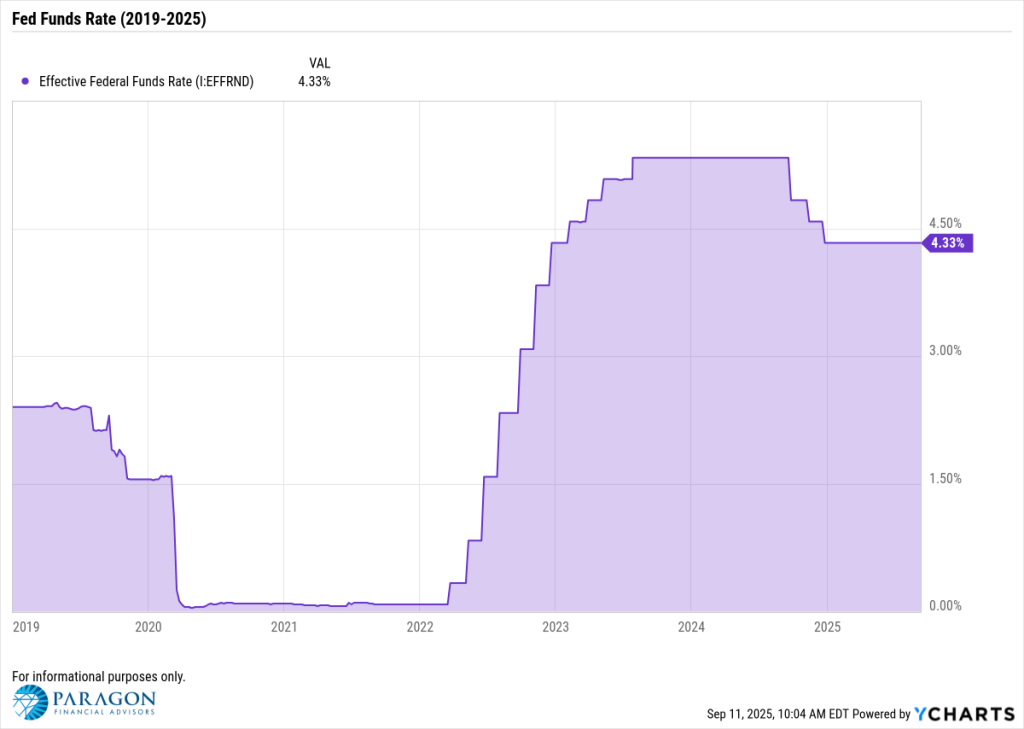
The U.S. economy presents a paradox that complicates monetary policy decisions. GDP growth rebounded to 3.0% annualized in Q2 2025 after a concerning -0.5% contraction in Q1, while unemployment has crept up to 4.3% from cycle lows. This mixed picture fuels intense debate about the appropriate policy path forward.
Major equity indices reflect this uncertainty, with the S&P 500 (SPY) showing resilience despite rate uncertainty, while small-caps (IWM) lag, suggesting concerns about tighter financial conditions’ impact on smaller companies. The technology-heavy Nasdaq (QQQ) continues to outperform, benefiting from the AI revolution that appears somewhat insulated from monetary policy shifts.
The persistence of services inflation at 4.9% annually remains the Fed’s primary concern. This stubborn inflation component, driven by wage pressures and structural factors in healthcare and housing, argues against premature easing.
The Case for Rate Cuts: Six Compelling Arguments
As detailed in the analysis of 6 reasons leading to Fed rate cuts, several factors support monetary easing:
- Economic Slowdown Signals
The Q1 2025 GDP contraction of -0.5% sent shockwaves through markets. While Q2’s 3.0% rebound provided relief, the Manufacturing PMI remains in contraction territory at 48.0, suggesting underlying economic weakness. Leading economic indicators point to deceleration ahead, with the Conference Board’s LEI declining for three consecutive months.
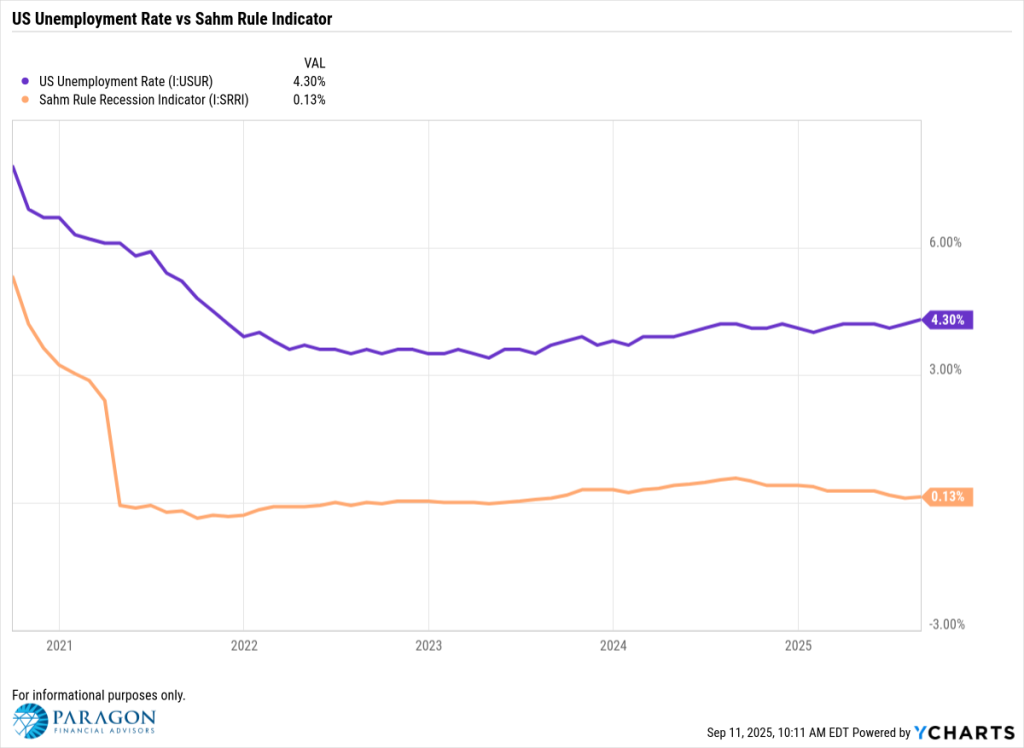
At 4.3%, unemployment approaches levels that historically trigger Fed action. The Sahm Rule recession indicator sits precariously close to its threshold, while wage growth has moderated to 4.3% year-over-year from peaks above 5%. Job openings have declined 25% from their peaks, indicating cooling labor demand.
- Disinflation Progress
Headline inflation has fallen dramatically from 9.1% to 2.7%, approaching the Fed’s 2% target. Market-based inflation expectations, as measured by 5-year TIPS breakevens, hover near 2.0-2.3%, suggesting confidence in continued disinflation. The dramatic decline in commodity prices and easing supply chain pressures support this trajectory.
- Global Economic Weakness
International growth concerns mount with the Eurozone growing at just 0.3%, China at 4.2% (well below historical norms), and the UK nearly stagnant at 0.1%. This synchronized global slowdown reduces inflationary pressures through weakened demand and lower commodity prices.
- Financial Conditions Assessment
Current policy sits approximately 200 basis points above neutral rate estimates of 2.5%, placing significant restriction on economic activity. Real rates (adjusted for inflation) exceed 1.5%, historically high levels that may unnecessarily constrain growth.
- Preemptive Action Precedent
Historical analysis shows the Fed often cuts rates preemptively to prevent recessions rather than react to them. With long and variable lags in monetary policy transmission, waiting for clear recession signals may prove too late.
The Case Against Cuts: Six Counterarguments
However, as examined in 6 reasons the Fed would hold rates, equally compelling arguments exist for maintaining current policy:
- Persistent Services Inflation
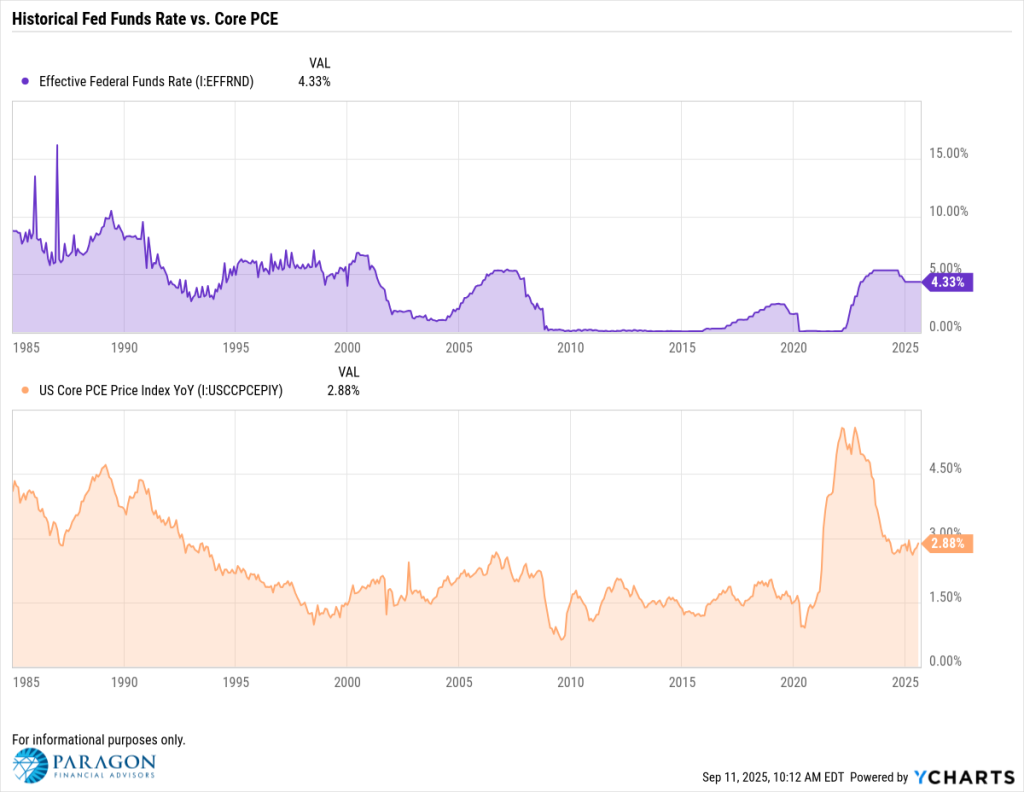
Services inflation at 4.9% remains more than double the Fed’s target, driven by structural factors unlikely to respond quickly to monetary policy. Healthcare, insurance, and transportation costs continue rising at uncomfortable rates, suggesting premature easing could entrench inflation expectations.
- Resilient Labor Market
Despite softening, 4.3% unemployment remains below long-term averages. The job openings-to-unemployed ratio at 1.3 indicates continued tightness, while 4.3% wage growth exceeds levels consistent with 2% inflation given productivity trends.
- Robust Consumer Spending
Real consumer spending grew 3.2% in Q2 2025, powered by accumulated pandemic savings, wealth effects from rising asset prices, and solid wage growth. Travel and leisure spending exceeds pre-pandemic levels, hardly suggesting an economy requiring stimulus.
- Loosened Financial Conditions
Despite elevated policy rates, financial conditions have paradoxically eased. The S&P 500’s 8.75% year-to-date gain, compressed credit spreads, and a weakening dollar (down 10%) all provide economic stimulus that could offset restrictive monetary policy.
- Global Central Bank Coordination
Major central banks remain hawkish, with the ECB and Bank of England maintaining restrictive stances. Unilateral U.S. rate cuts could trigger currency market disruptions and import inflation through a weaker dollar.
- Credibility Preservation
After the inflation surge of 2021-2023, the Fed must protect its hard-won credibility. Premature easing that allows inflation to reaccelerate would damage long-term inflation expectations anchoring, potentially requiring even more aggressive tightening later.
Sector and Asset Class Implications
Winners in a Rate-Cut Scenario:
- Real Estate (REITs): Lower rates reduce financing costs and increase property valuations
- Utilities: High-dividend sectors become more attractive as bond yields fall
- Technology Growth: Lower discount rates favor long-duration growth assets
- Small Caps: Reduced borrowing costs disproportionately benefit smaller companies
- Emerging Markets: Dollar weakness and improved liquidity conditions
Winners if Rates Hold:
- Financials: Banks benefit from wider net interest margins
- Money Market Funds: Continue attracting assets with 4%+ yields
- Value Stocks: Higher rates favor profitable, cash-flowing businesses
- Dollar Assets: Continued rate differential supports USD strength
Conclusion: Navigating Unprecedented Uncertainty
The great rate-cut debate of 2025 reflects genuine uncertainty about the economy’s trajectory and appropriate policy response. While markets price in substantial easing, the case for maintaining restrictive policy remains credible given persistent inflation and economic resilience.
As the debate intensifies heading into the Fed’s autumn meetings, one certainty emerges: the decisions made in 2025 will shape market dynamics for years to come. Whether the Fed cuts aggressively, moderately, or holds steady, investors must prepare for multiple scenarios while maintaining discipline and focusing on long-term objectives.
Disclaimer
©2025 YCharts, Inc. All Rights Reserved. YCharts, Inc. (“YCharts”) is not registered with the U.S. Securities and Exchange Commission (or with the securities regulatory authority or body of any state or any other jurisdiction) as an investment adviser, broker-dealer or in any other capacity, and does not purport to provide investment advice or make investment recommendations. This report has been generated through application of the analytical tools and data provided through ycharts.com and is intended solely to assist you or your investment or other adviser(s) in conducting investment research. You should not construe this report as an offer to buy or sell, as a solicitation of an offer to buy or sell, or as a recommendation to buy, sell, hold or trade, any security or other financial instrument. For further information regarding your use of this report, please go to: ycharts.com/about/disclosure
RISK DISCLOSURE: Investing involves risk including the potential loss of principal. No investment strategy can guarantee a profit or protect against loss in periods of declining values. Past performance does not guarantee future results.
This material is for information purposes only and is not intended as an offer or solicitation with respect to the purchase or sale of any security. The content is developed from sources believed to be providing accurate information; no warranty, expressed or implied, is made regarding accuracy, adequacy, completeness, legality, reliability, or usefulness of any information. Consult your financial professional before making any investment decision. For illustrative use only.
SECURITY REMINDER: E-mail transmission may not be secure. If you would like to be contacted by other means please alert Paragon Financial Advisors. By your use of email, Paragon Financial Advisors assumes you agree to our transmission of information by e-mail. Please do NOT send Social Security numbers or account numbers, confidential or privileged information via E-mail.
CONFIDENTIALITY NOTICE: All e-mail sent to or from this address will be received or otherwise recorded by Paragon Financial Advisors and is subject to archival, monitoring or review by, and/or disclosure to the Securities and Exchange Commission. This email and any files transmitted with it are confidential and are intended solely for the use of the individual or entity to which they are addressed. This communication represents the originator’s personal views and opinions, which do not necessarily reflect those of Paragon Advisors. If you are not the original recipient or the person responsible, be advised that you have received this email in error, and that any use, dissemination, forwarding, printing, or copying of this email is strictly prohibited. If you received this email in error, please immediately notify info@paragon-adv.com.
Category

© 2026 Paragon Advisors, LLC. All rights reserved. | Site Credit: Kasey S Consulting