
Is now the right time to invest?
September 3, 2026
The short answer: the historical data consistently favors investing now over waiting. Across every scenario (worst-case entry timing, panic-selling during a crash, or missing the market’s best days), the cost of waiting has historically outweighed the cost of imperfect timing
The S&P 500 spent the first half of 2026 setting 24 new all-time highs, continuing a bull market that has stretched more than 3.7 years and seen the index increase by more than 104% since October 2022. This run, while still shorter than the average bull market’s 5.4 years, comes with its own warning signs:
- Tech overconcentration: Technology now accounts for more than 37% of the S&P 500 index by weight, an all-time record.
- AI valuation concerns: Extreme capital expenditures and lofty AI valuations have raised bubble comparisons.
- Geopolitical risk: Ongoing tensions in the Middle East and elevated inflation continue to cloud the economic outlook.
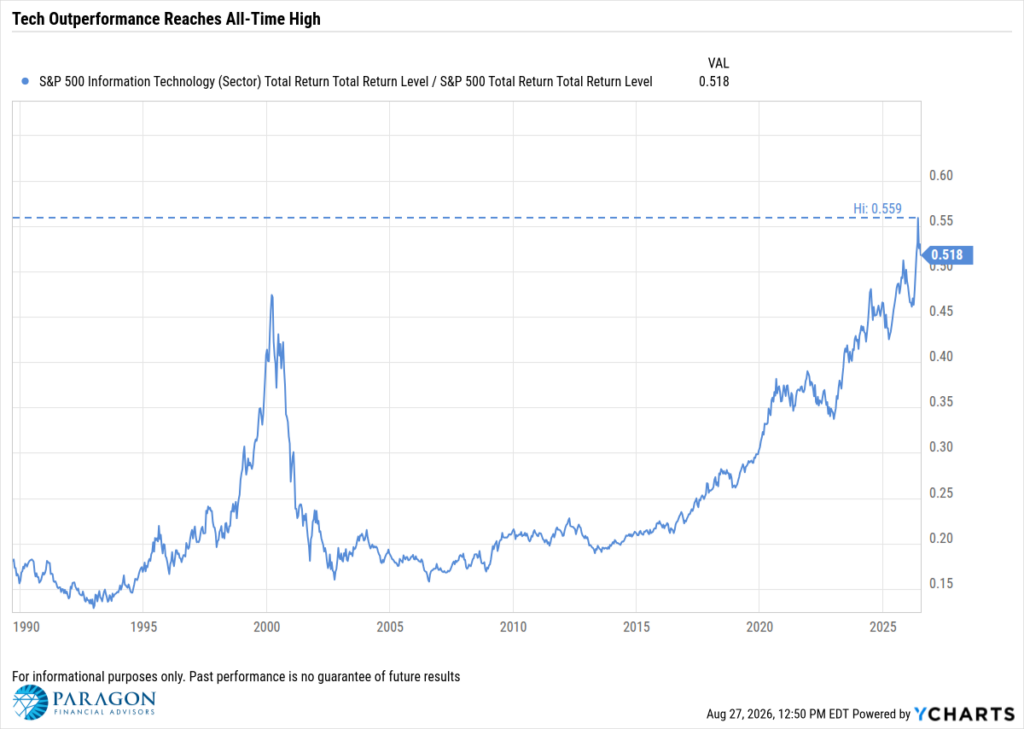
Against this backdrop, clients are asking the question that surfaces in every uncertain market: Should I wait for a pullback, move to the sidelines, or invest now?
No advisor can answer with certainty. But the historical record on waiting is far more decisive than the question itself suggests.
What Happens If You Invest at the Worst Possible Moment?
Even the worst-timed investment in recent history still produced strong long-term returns. Consider an investor who deployed $100,000 into the S&P 500 on February 19, 2020, the absolute peak before the COVID-19 crash.
- In 33 days, the S&P 500 fell 33.9%, erasing roughly $34,000.
- Compare that to an investor who spread the same $100,000 across the next twelve months via dollar-cost averaging (DCA), buying into the crash and recovery.
Five years later, both strategies gained more than 80%. Despite buying at the single worst possible moment, the lump-sum investor finished just 6.3% behind the DCA approach.
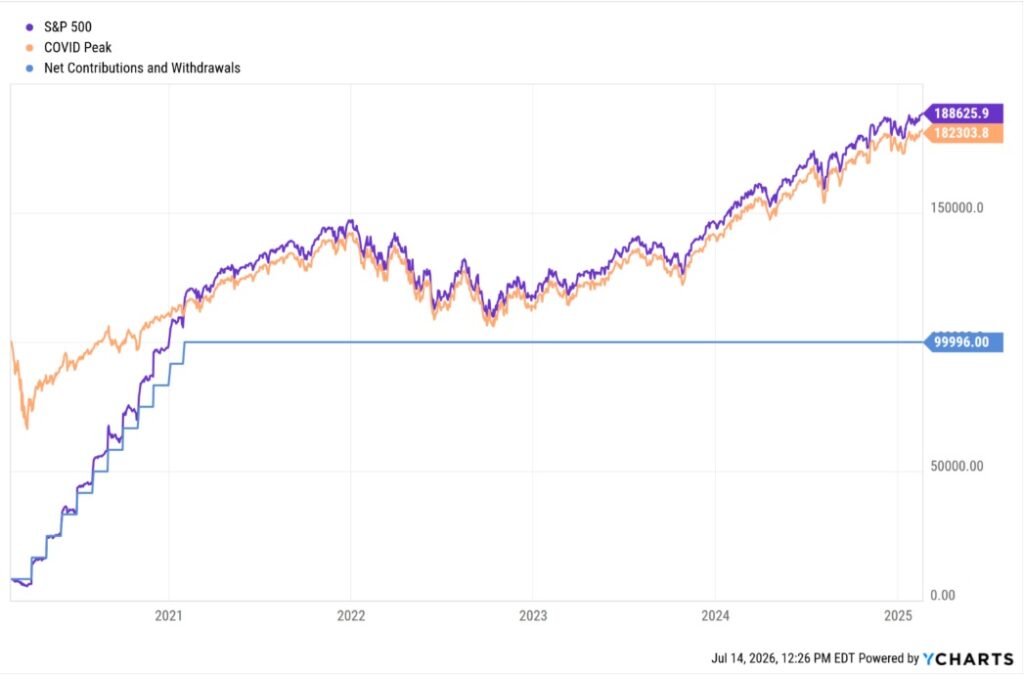
The takeaway: entry timing matters less than clients fear. The ability to remain invested through volatility plays a far more important role.
What Is the Real Cost of Moving to Cash During a Downturn?
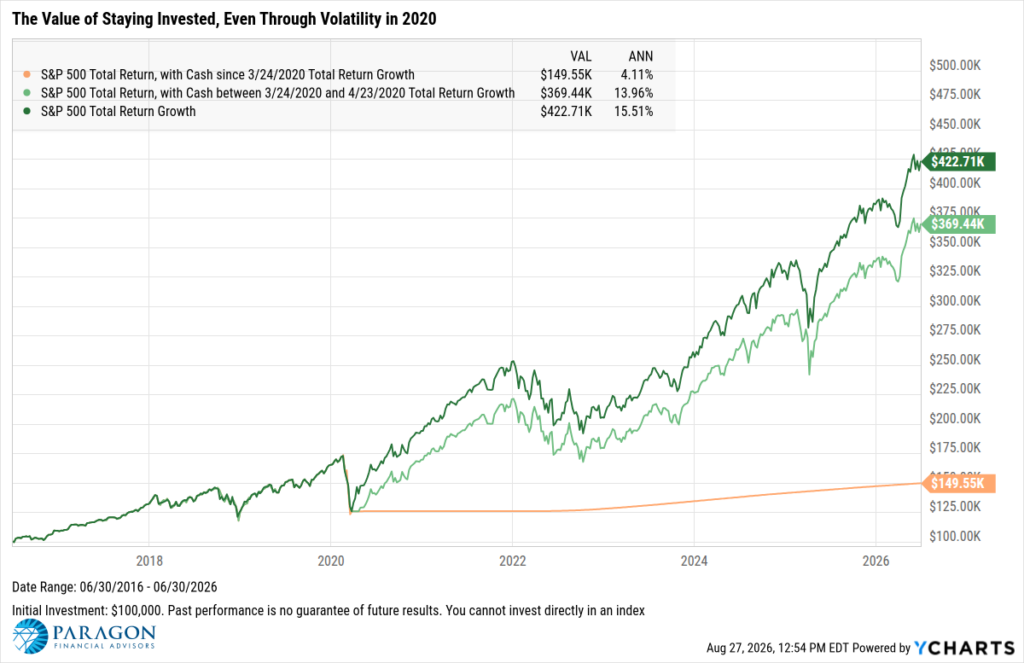
Stepping out of the market, even briefly, has a measurable and lasting cost. Using YCharts scenario analysis, we can illustrate exactly what happens when investors try to “wait for things to calm down”:
- An investor who moved to cash for just one month at the bottom of the COVID crash would have sacrificed more than $25,000 over five years.
- An investor who moved to cash and never returned ended the period with annualized losses of -2.90%, finishing 18 percentage points per year behind someone who did nothing at all.
Does Staying Invested Longer Produce Meaningfully Better Returns?
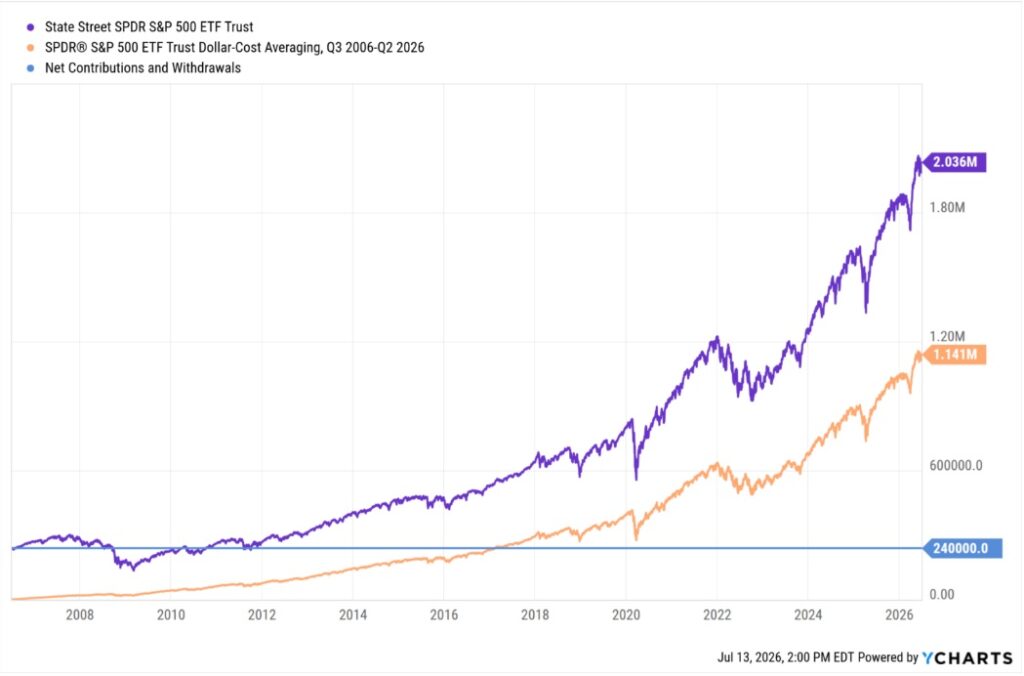
The longer the time horizon, the more dramatically compounding favors early, sustained investment. Looking at a 20-year window that included two major recessions:
- A lump sum investment of $240,000 made 20 years ago returned 748% total.
- The same amount invested via monthly DCA contributions returned 375%.
- The difference in ending wealth: nearly $900,000.
The same principle applies to timing an exit and attempting a re-entry. YCharts data across a 25-year window shows the cost of missing the market’s best days:
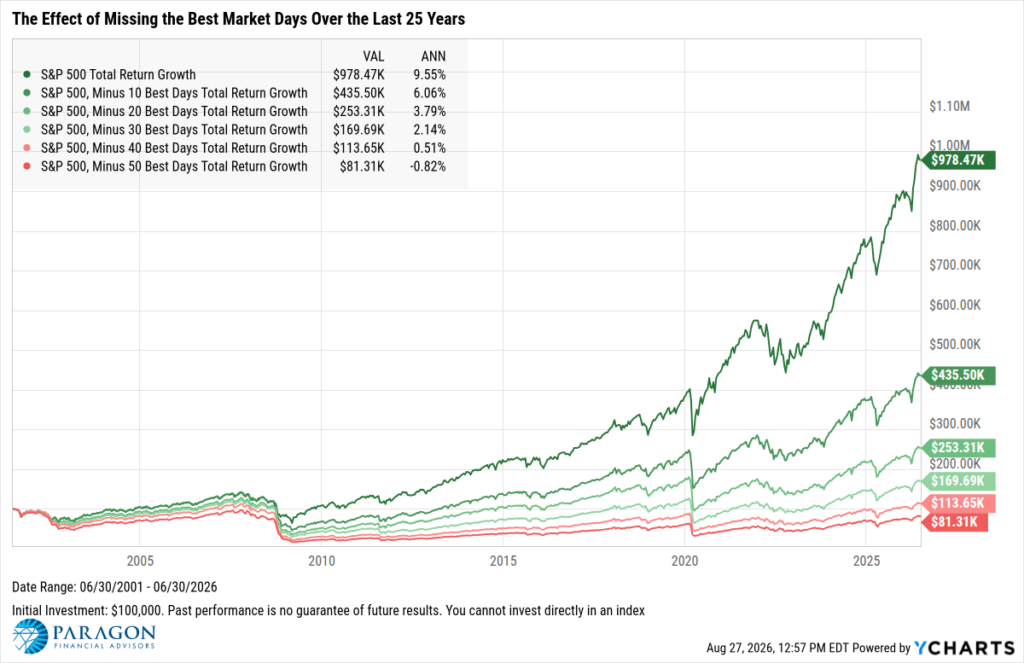
Missing just the 10 best market days over 25 years cut annualized returns by more than a third. These best days are impossible to predict, and they tend to cluster very close to the worst ones.
There’s Always a Reason to Sell
Many of these best days have shown up during periods that felt like exactly the wrong time to be invested. Since 1990, the S&P 500 has weathered the dot-com collapse, the 2008 financial crisis, a global pandemic, and many more events that each felt a legitimate reason to step back.
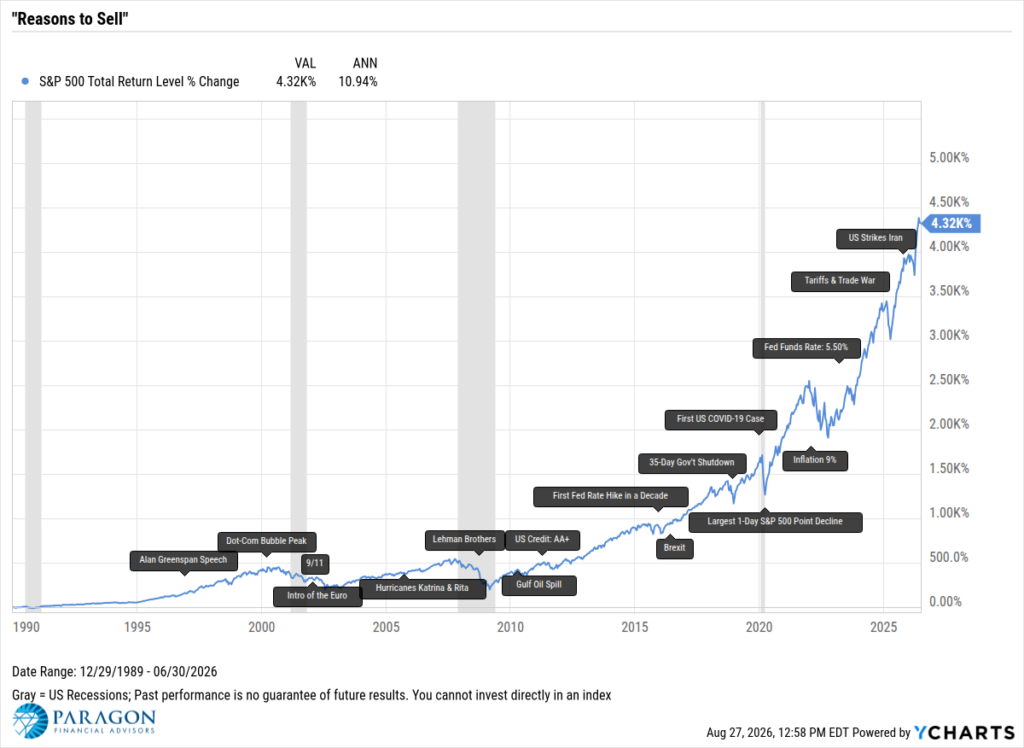
Today’s AI valuation concerns, elevated rates, and conflict in the Middle East raise the same instinct to step back, yet through all of those, the index has returned 4,320% at an annualized rate of 10.94%.
Is Now the Right Time to Invest?
The answer is that nobody knows what the next six months hold. The data across the worst possible entry point, panicking and moving to cash, and missing the market’s best days all point to the same conclusion: the cost of waiting has historically outweighed the cost of being wrong about timing.
Disclaimer
©2026 YCharts, Inc. All Rights Reserved. YCharts, Inc. (“YCharts”) is not registered with the U.S. Securities and Exchange Commission (or with the securities regulatory authority or body of any state or any other jurisdiction) as an investment adviser, broker-dealer or in any other capacity, and does not purport to provide investment advice or make investment recommendations. This report has been generated through application of the analytical tools and data provided through ycharts.com and is intended solely to assist you or your investment or other adviser(s) in conducting investment research. You should not construe this report as an offer to buy or sell, as a solicitation of an offer to buy or sell, or as a recommendation to buy, sell, hold or trade, any security or other financial instrument. For further information regarding your use of this report, please go to: ycharts.com/about/disclosure
RISK DISCLOSURE: Investing involves risk including the potential loss of principal. No investment strategy can guarantee a profit or protect against loss in periods of declining values. Past performance does not guarantee future results.
This material is for information purposes only and is not intended as an offer or solicitation with respect to the purchase or sale of any security. The content is developed from sources believed to be providing accurate information; no warranty, expressed or implied, is made regarding accuracy, adequacy, completeness, legality, reliability, or usefulness of any information. Consult your financial professional before making any investment decision. For illustrative use only.
SECURITY REMINDER: E-mail transmission may not be secure. If you would like to be contacted by other means please alert Paragon Financial Advisors. By your use of email, Paragon Financial Advisors assumes you agree to our transmission of information by e-mail. Please do NOT send Social Security numbers or account numbers, confidential or privileged information via E-mail.
CONFIDENTIALITY NOTICE: All e-mail sent to or from this address will be received or otherwise recorded by Paragon Financial Advisors and is subject to archival, monitoring or review by, and/or disclosure to the Securities and Exchange Commission. This email and any files transmitted with it are confidential and are intended solely for the use of the individual or entity to which they are addressed. This communication represents the originator’s personal views and opinions, which do not necessarily reflect those of Paragon Advisors. If you are not the original recipient or the person responsible for delivering the email to the intended recipient, be advised that you have received this email in error, and that any use, dissemination, forwarding, printing, or copying of this email is strictly prohibited. If you received this email in error, please immediately notify info@paragon-adv.com
Category

© 2026 Paragon Advisors, LLC. All rights reserved. | Site Credit: Kasey S Consulting