
Debunking Investing Myths
August 13, 2024
What Doesn’t Drive Long-Term Returns
As someone who invests in their
future, you’re likely eyeing what drives investment returns.
But it’s all-too-easy to be distracted
by a number of investment myths. These are nothing but short-term noise that
can cause you to miss the big picture of long-term gains.
And it’s no one’s fault. These
investment myths are so widespread that even seasoned pros might swear by them.
To make smarter money moves, you need
to separate fact from fiction and focus on what really
matters.
So, let’s clear the air.
WITH SO MANY FACTORS IMPACTING INVESTMENT RETURNS, IT’S TOUGH TO TELL WHAT’S REAL.
WHILE OFTEN THOUGHT TO INFLUENCE THE MARKET, THE FOLLOWING 3 MYTHS HAVE, HISTORICALLY, LITTLE-TO-NO BEARING ON LONG-TERM RETURNS.
MYTH #1: EARNINGS REPORTS ARE A PRIMARY DRIVER OF INVESTMENT RETURNS.
FACT: Investment returns and earnings reports have shown little to no correlation.
Each quarter, investors wait on pins and needles for their favorite companies to release earnings reports.
While these offer important updates on how the company is performing and their challenges ahead, they’re a poor barometer for long-term investment returns. And there’s a tendency to greatly overvalue earnings reports when considering a potential investment.
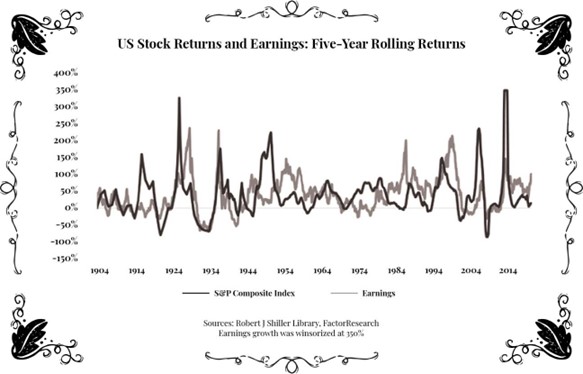
If earnings were an indicator of investment returns, we would expect to see earnings growth preceding a rise in investment returns.
But this isn’t the case.
Looking at the S&P Composite Index, we can see that earnings and returns do not align as expected. In fact, over the past century, there is almost no correlation between earnings growth and investment returns.1
Takeaway: EARNINGS SHOULD BE TAKEN INTO LIGHT CONSIDERATION, BUT DON’T LET THESE QUARTERLY CALLS INFLUENCE YOUR LONG-TERM INVESTING GOALS.
MYTH #2 GEOPOLITICAL CRISES ARE LONG-TERM INVESTMENT NEGATIVES.
FACT: A geopolitical crisis can cause minor, short-term declines, but usually does not affect the long-term market outlook.
Regional tensions in Russia, the Middle East, and China are causing investors to fear another world war.
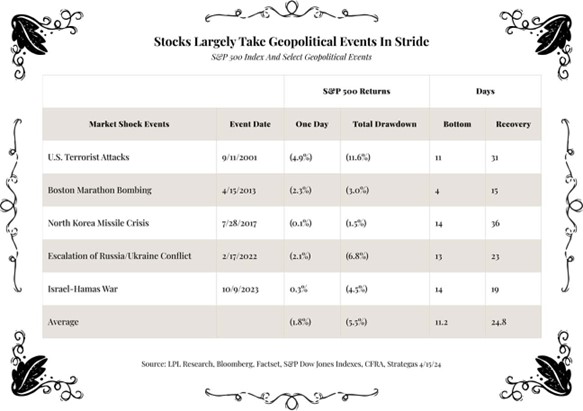
You might wonder if these fears are reason to be hesitant about your investments, but history shows that while these occurrences may cause temporary volatility, the market is quite resilient to even the most negative geopolitical events.
In the short-term, the market tends to drop 1% following a geopolitical crisis event, with the total average drawdown being only 4.7% to the negative. When looking at the long-term effects of such events, the outlook is even more optimistic. The average market return in the 12-month period following a major geopolitical crisis was +2.1%, displaying just how resilient markets are, and how these events only had a short-term impact on returns.2
Takeaway: GEOPOLITICAL CRISES ARE SHORT-TERM BLIPS ON THE LONGER-TERM RADAR OF INVESTING.
MYTH #3: PERIODS OF EXTREMELY HIGH OR LOW VALUATIONS ARE SUSTAINABLE IN THE RIGHT CONDITIONS.
FACT: Stock valuations almost always gravitate back toward their long-term averages.
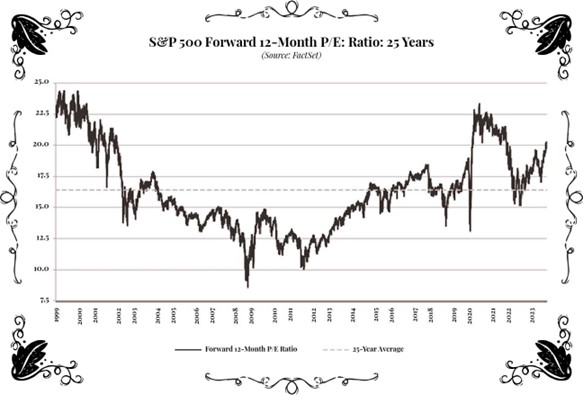
When examining price-to-earnings (P/E) multiples over time, it appears that stocks can go through periods of extremely high (and low) valuations, but these are never sustained. As seen in the chart below, the 25-year average P/E ratio for the S&P 500 is 16.4, and even though the market has fluctuated above and below this average, valuations usually revert back toward this average.
Takeaway: EXTREME VALUATIONS WILL LIKELY STEADY OVER TIME, SO USE CAUTION WHEN ADJUSTING YOUR STRATEGY DURING THESE DRASTIC PERIODS.
“Patience is the companion of wisdom.”
FINANCIAL LESSON: AVOID THE HYPE. PRACTICE THE FUNDAMENTALS. FOCUS ON THE LONG-TERM
If factors like earnings reports and geopolitical events don’t influence stock returns, then what does?
For long-term investors, fundamentals are still the bread and butter of valuing stocks. This includes earnings growth, dividends, and cash flows.
The market will always fluctuate based on recent news and events; however, understanding how much weight to give what you hear (or scroll through) can help you make decisions with a greater sense of confidence.
Sources
- https://blogs.cfainstitute.org/investor/2021/03/22/myth-busting-earnings-dont-matter-much-for-stock-returns/
- https://www.lpl.com/research/blog/middle-east-conflict-how-stocks-react-to-geopolitical-shock.html
- https://insight.factset.com/sp-500-forward-p/e-ratio-rises-above-20.0-for-first-time-in-2-years
Chart Sources
- https://blogs.cfainstitute.org/investor/2021/03/22/myth-busting-earnings-dont-matter-much-for-stock-returns/
- https://www.lpl.com/research/blog/middle-east-conflict-how-stocks-react-to-geopolitical-shock.html
- https://insight.factset.com/sp-500-forward-p/e-ratio-rises-above-20.0-for-first-time-in-2-years
RISK DISCLOSURE: Investing involves risk including the potential loss of principal. No investment strategy can guarantee a profit or protect against loss in periods of declining values. Past performance does not guarantee future results.
This material is for information purposes only and is not intended as an offer or solicitation with respect to the purchase or sale of any security. The content is developed from sources believed to be providing accurate information; no warranty, expressed or implied, is made regarding accuracy, adequacy, completeness, legality, reliability, or usefulness of any information. Consult your financial professional before making any investment decision. For illustrative use only.
SECURITY REMINDER: E-mail transmission may not be secure. If you would like to be contacted by other means please alert Paragon Financial Advisors. By your use of email, Paragon Financial Advisors assumes you agree to our transmission of information by e-mail. Please do NOT send Social Security numbers or account numbers, confidential or privileged information via E-mail.
CONFIDENTIALITY NOTICE: All e-mail sent to or from this address will be received or otherwise recorded by Paragon Financial Advisors and is subject to archival, monitoring or review by, and/or disclosure to the Securities and Exchange Commission. This email and any files transmitted with it are confidential and are intended solely for the use of the individual or entity to which they are addressed. This communication represents the originator’s personal views and opinions, which do not necessarily reflect those of Paragon Advisors. If you are not the original recipient or the person responsible for delivering the email to the intended recipient, be advised that you have received this email in error, and that any use, dissemination, forwarding, printing, or copying of this email is strictly prohibited. If you received this email in error, please immediately notify info@paragon-adv.com
Category

© 2026 Paragon Advisors, LLC. All rights reserved. | Site Credit: Kasey S Consulting