
Fed Cuts Rates Again, Signals It May Be Done for Now
December 18, 2025
Fed Cuts Rates Again, Signals It May Be Done for Now
Federal Reserve officials cut interest rates at their third consecutive meeting but signaled little appetite for more amid unusual internal divisions over whether inflation or the job market should be their bigger worry.
The Fed voted 9-3 for the reduction on Wednesday, the first time in six years that three officials cast dissents. Chicago Fed President Austan Goolsbee and Kansas City Fed President Jeff Schmid thought the reduction wasn’t warranted, while Fed governor Stephen Miran favored a larger, half-point cut.
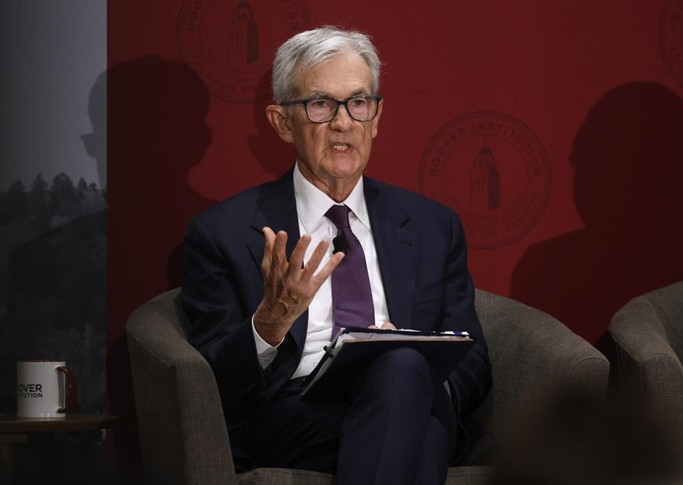
Jerome Powell’s term as chair expires in May, meaning he will preside over just three more rate-setting meetings.Photo: Justin Sullivan/Getty Images
The decision to reduce the benchmark federal-funds rate by a quarter point—to between 3.5% and 3.75%, a three-year low—is aimed at protecting against a sharper-than-anticipated slowdown in hiring.
With progress on inflation stalled, officials had indicated in the run-up to this week’s decision that further reductions could require evidence of labor-market deterioration.
On Wednesday, their painstakingly calibrated postmeeting statement signaled a higher bar to additional cuts—echoing a similar pivot to the sidelines after cutting rates one year ago—by saying that the “extent and timing” of those moves would depend on changes in the economic outlook.
The Fed no longer described the unemployment rate, which ticked up to 4.4% in September from 4.1% earlier this year, as having remained low.
Not every Fed official who participates in the meeting has a vote on the committee. In new quarterly projections, six of 19 officials penciled in a year-end rate above the level before Wednesday’s cut—a sign that some voters backed the cut with reservations or that nonvoters were opposed.
The projections also showed a majority of officials penciled in at least one reduction next year. That was the same as in September and suggests officials see little reason to accelerate the pace of easing.
Public comments from Fed officials in recent weeks revealed a committee so fractured that the decision likely came down to how Fed Chair Jerome Powell wanted to proceed.
Powell’s term as chair expires in May, meaning he will preside over just three more rate-setting meetings. President Trump has said he is close to naming a successor—raising questions about whether whoever follows will be able to command the same deference.
Inflation-wary hawks see a central bank cutting into an economy that is stronger than it looks and worry that interest rates may no longer be high enough to put downward pressure on inflation. That’s a bigger worry with each passing year, since inflation has been running above the Fed’s target since 2021.
By contrast, employment-focused doves see little evidence that lower rates are reviving sluggish housing and labor markets. With the latest reduction, the Fed will have cut rates by 1.75 percentage point in the last 15 months. They worry the risks are asymmetric: If unemployment accelerates, fixing it will require far more aggressive action than if inflation lingers near 3%.
Powell has sided with the doves since the jobs picture darkened in August, but the dissents and hawkish guidance underscored how he is navigating with the thinnest internal support of his tenure.
The combination of firm price pressures alongside a cooling labor market presents an unsavory trade-off for the Fed, one it hasn’t faced in decades. When officials confronted a similar dilemma, during the so-called stagflation of the 1970s, the central bank’s stop-and-go response allowed high inflation to become entrenched.
The fed-funds rate, which is what the Fed controls, influences short-term borrowing costs throughout the economy, including rates on credit cards and auto loans. Longer-term interest rates, which matter more for mortgages and business investment, have notched more modest declines since the Fed began to cut rates last year.
The 10-year Treasury yield, which dropped to 4.01% ahead of the Fed’s first cut in September, stood at 4.185% on Tuesday. That has limited the relief for would-be home buyers and others hoping lower rates would ease borrowing costs.
Every decision to lower rates is becoming more contested as rates move closer to a so-called neutral setting that neither spurs nor slows economic activity. With each cut, “you’re just going to lose the support of a few more participants, and you’re going to need data to motivate those participants to want to join with the majority to get a cut,” said Jonathan Pingle, chief U.S. economist at UBS.
Powell justified the cuts that began in September as insurance against a weakening labor market—a sequence he first telegraphed in his Jackson Hole address in August. It can take time for those reductions to influence economic conditions. The challenge now is signaling that phase is complete without ruling out further action if the job market cracks.
The Labor Department is set to release employment data for October and November next week, and Fed officials will also have December job readings before their next meeting in late January. The coming data deluge complicates any effort to strongly signal intentions.
A rise in jobless claims, evidence of rising layoffs and a steady grind higher in the unemployment rate would be a “very uncomfortable constellation of events for the core of the committee,” Pingle said. “They’re not planning on a January cut, but I don’t think this chair, at this juncture, is able to rule anything out.”
Data that show whether more troubling scenarios for inflation are materializing will also be important. The Labor Department is set to report the November consumer-price index next week.
Nathan Sheets, global chief economist at Citi, said he is watching January price data to see if businesses that have held back tariff-related cost increases reset prices higher at the start of the year. “If we are going to see more tariff pass-through, the natural time for it to come is during those annual pricing increases,” he said.
Sheets is among those who worry the Fed has little margin for error on inflation. The Fed targets an inflation rate of 2%, but a key measure of inflation stood at 2.8% in September.
“I don’t think inflation is going to break out on the upside, but by the same token, you’re not at 2% and there’s no compelling narrative that you’re going to get back to 2% anytime soon,” he said. “And that definitely gives me pause.”
Write to Nick Timiraos at Nick.Timiraos@wsj.com
This Wall Street Journal article was legally licensed by AdvisorStream.
Dow Jones & Company, Inc.
Disclosures: Used with permission from The Wall Street Journal, WSJ.com. Copyright 2025 Dow Jones & Company, Inc. All rights reserved.
RISK DISCLOSURE: Investing involves risk including the potential loss of principal. No investment strategy can guarantee a profit or protect against loss in periods of declining values. Past performance does not guarantee future results.
This material is for information purposes only and is not intended as an offer or solicitation with respect to the purchase or sale of any security. The content is developed from sources believed to be providing accurate information; no warranty, expressed or implied, is made regarding accuracy, adequacy, completeness, legality, reliability, or usefulness of any information. Consult your financial professional before making any investment decision. For illustrative use only.
SECURITY REMINDER: E-mail transmission may not be secure. If you would like to be contacted by other means please alert Paragon Financial Advisors. By your use of email, Paragon Financial Advisors assumes you agree to our transmission of information by e-mail. Please do NOT send Social Security numbers or account numbers, confidential or privileged information via E-mail.
CONFIDENTIALITY NOTICE: All e-mail sent to or from this address will be received or otherwise recorded by Paragon Financial Advisors and is subject to archival, monitoring or review by, and/or disclosure to the Securities and Exchange Commission. This email and any files transmitted with it are confidential and are intended solely for the use of the individual or entity to which they are addressed. This communication represents the originator’s personal views and opinions, which do not necessarily reflect those of Paragon Advisors. If you are not the original recipient or the person responsible for delivering the email to the intended recipient, be advised that you have received this email in error, and that any use, dissemination, forwarding, printing, or copying of this email is strictly prohibited. If you received this email in error, please immediately notify info@paragon-adv.com
Category

© 2026 Paragon Advisors, LLC. All rights reserved. | Site Credit: Kasey S Consulting